Art Inspired by Nature, Culture and Tradition

Khokhloma and Crimson Sails
Two childhood memories embracing each other
GulnArt
12/11/2025
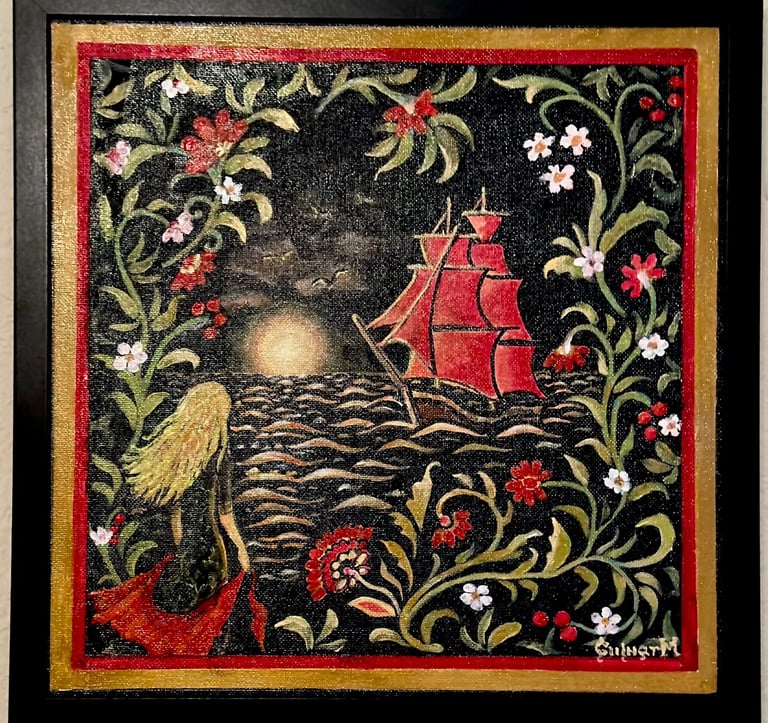
Fourth Memory — Everyday Beauty
When I was young, Khokhloma wasn’t a souvenir or a luxury item. It was everyday life.
Before plastics became common, Khokhloma utensils and furniture filled homes across the region—bright, useful, and beautifully crafted. Kid-sized chairs and tables, mixing bowls, trays, and of course the famous spoons… all painted with those swirling leaves, gold highlights, and deep reds that seemed to glow from within.
At home we used Khokhloma spoons for soup, and I had my own little set. They weren’t special-occasion things, they were simply there, part of our daily life. No one thought of them as fragile art; Khokhloma was meant for use. The utensils were washable, heatproof, and sturdy—and that practicality only added to their charm.
Looking back, I think those early encounters shaped my eye long before I knew what it meant to be an artist. The elegance of the curves, the stylized flowers, the way gold and red danced together… all of it captured my curiosity. I remember wondering even as a child: How do they make them glow like that? (I learnt it only recently)
That curiosity was probably the first spark of my lifelong love for folk arts. With time, Khokhloma became more than a memory of childhood. It became nostalgia, comfort, and a quiet thread tying me to my childhood.
How Khokhloma Met Crimson Sails
There was another memory that stayed with me just as strongly, though in a different way: the story of Crimson Sails. To me, it was the fairy tale equivalent of a prince on a white horse—yet so much deeper and more hopeful. A story about dreams so bold that the world eventually has no choice but to meet them.
I carried that story with me through the years. And decades later, I told it to my granddaughter. She fell in love with it immediately, completely, and—as it turned out—permanently. Even after she grew up, married, and started her own life, we talked about Crimson Sails recently. It still was our little shared magic.
That is when I felt a sudden urge to paint it. But I didn’t want it to look like a simple book illustration. That story deserved something richer, something that belonged to me.
And that is when my two worlds met. Khokhloma wrapped its golden vines around the sea.
Red blossoms echoed the glowing sails. Art admired in childhood framed a childhood fairy tale.
The painting almost created itself—two memories, two influences, merging from different times of my life into one canvas.
Subscribe to our newsletter
Get notified about new blog posts and more